T-shirt printing
Produce T-shirts for merchandise, teams, events and fashion using the right printing method for each fabric and design.
Choose the right T-shirt printing method
Different T-shirts need different printing approaches.
With DTF (Direct-to-Film), you print the design onto transfer film. Then you add adhesive powder, cure it and heat-press the design onto the garment. It works well with cotton, polyester and blended fabrics. So, it is good choice when one business handles several garment types.
Sublimation printing follows a different process. First, you print the design onto sublimation paper. Then, you use heat and pressure to bond the dye with the polyester fibres. You can also print directly onto suitable polyester fabrics before heat fixation. This sublimation method is only suitable for polyester fabrics.
With heat-transfer vinyl (HTV, also known as flex), there are two methods:
- The cutting film for which you only need a vinyl cutter.
- a printable version for which you can use an eco-solvent print-and-cut system to print and cut the design.
You then apply the vinyl to the garment using a heat press. The advantage for cutting film is that other optics like gold, silver, holographic and more are possible. This method works well for simple logos, names and numbers on ready-made garments.
Other T-shirt printing methods also have their place. DTG prints ink directly onto the pre-treated garments, and works especially well for detailed, full-colour designs on cotton. Screen printing takes more setup and becomes more expensive if you use more than one color, but it is often a better choice for larger runs of the same design. The best method depends on the fabric, artwork, order size and required finish.


Plan the full DTF workflow
DTF is a widely used method for professional T-shirt printing, but its workflow continues beyond the printer. Printer speed alone does not determine DTF production capacity. Powder application, curing and heat pressing also need to keep up. If one stage is slower, it can become a bottleneck as order volumes grow.
To avoid this, plan the powdering, curing and heat-press capacity around your expected production volume. Mimaki recommends using a shaker and dryer unit to apply and cure the powder evenly. For heat pressing, use the time, temperature and peeling method recommended by the film supplier. Test the film, powder, garment and press settings together before starting commercial production.
To support this DTF workflow, Mimaki’s TxF Series also uses white ink circulation and automatic nozzle checking to help keep the printing stable. However, the finishing equipment still needs enough capacity to handle the printed transfers to not slow down the overall workflow.
More information about DTF printersKeep personalised and repeat orders under control
Custom T-shirt printing can turn one order into dozens of artwork variations. Names, numbers, sizes and individual designs need to remain correctly matched while production continues at a practical pace.
Digital workflows can reduce repeated file preparation. Mimaki RasterLink7 supports variable data printing. This means that it is possible for names, numbers or other details to change while the main design stays the same. This saves a lot of time and can reduce repeated file preparation when producing personalised T-shirts in larger quantities.

Compare T-shirt printing methods
Which T-shirt printing method is right for your production? In this 15-minute video, explore screen printing, heat transfer, DTG and DTF, with a closer look at DTG and DTF printing. If you’re comparing these technologies or already using one of them, this video can help you understand the differences better. It can also help you see which approach may suit your production needs.
T-shirt printing for different production needs
T-shirt printing supports many jobs, from branded merchandise to team shirts and on-demand personalisation. Each use case brings different requirements for design variation, garment type and order volume.

Custom and branded T-shirts
Custom T-shirt printing is used for fashion collections, branded merchandise and limited-edition designs. These jobs often combine standard graphics with short runs or frequent artwork changes.
DTF works well for this type of production because you can apply the transfers to cotton, polyester and blended garments. It also allows businesses to produce different designs without preparing a separate analogue setup for every variation. You also have the possibility to personalise or inprint an already printed shirt. This can help support faster turnaround for short runs and personalised orders.
Sports and team T-shirts
Team T-shirts often combine the same club or sponsor design with different names, numbers and sizes. The fabric also affects the printing method, as many performance T-shirts use polyester.
Sublimation works well when producing polyester garments. These fabric panels will have to be confectioned after sublimation. Afterwards, DTF and heat-applied graphics can still be added to the finished T-shirt, but keep in mind that for sublimation shirts a special powder or a lower heat-pressing temperature might be recommended.


Event and on-demand T-shirts
Events, retail activations and personalised merchandise can require every shirt to have a different design. The workflow therefore needs to handle artwork variation without adding unnecessary setup time.
Mimaki showed this in practice at Google Cloud AI Live Milano 2026. Visitors created their own designs using Google Gemini AI. The designs were then printed onto DTF transfer film using a Mimaki TxF300-75Plus and transferred onto T-shirts. The result: each visitor received a unique, personalised T-shirt produced on-demand during the event.
For print businesses, this opens the door to personalised jobs where every T-shirt can be different. Designs can change from shirt to shirt without repeating the full setup each time.
When AI Becomes Wearable with Google and Mimaki DTF TechnologyMimaki printers ideal for T-shirt printing
Mimaki supports T-shirt production with different printing technologies for different needs. DTF printers suit finished cotton, polyester and blended garments. Sublimation printers are suitable for polyester-based apparel. Eco-solvent print-and-cut systems can be used to print and cut a heat-transfer vinyl. Cutting plotters can also be used for heat-transfer-vinyl. You can then use all of these solutions to create logos, names, numbers and graphics for T-shirts.
-
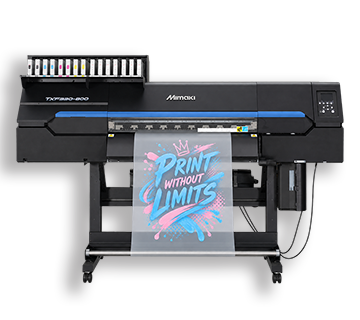
TxF330-800
High production Direct-to-Film (DTF) printer
- New sky blue and pale pink inks
- 330 Series print engine for detailed image quality
- Mimaki Feed Tension to maintain image consistency
- Reliable output across a wide range of DTF films

-
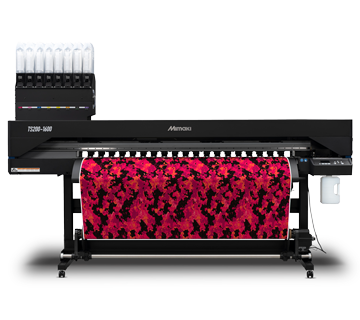
TS200-1600
Affordable entry model with pro-level performance
- Powerful solution for sportswear, fashion and decor
- Orange, violet and flourescent inks for bold and vivid brilliance
- Superior performance with 330 Series technology
- 2-litre ink packs for longer printer runs
-
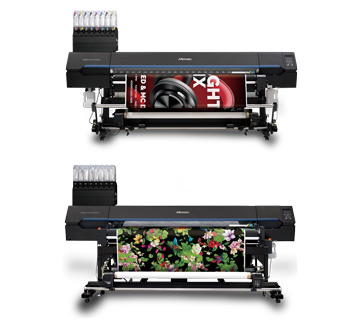
Tx330 Series
Next-gen hybrid printer for vibrant, eco-friendly textiles
- Prints 25% faster at high resolution
- Hybrid printer handles both fabrics and sublimation
- Belt-driven model for stretchy or thick fabrics
- Employs eco-friendly "waterless" technology
-
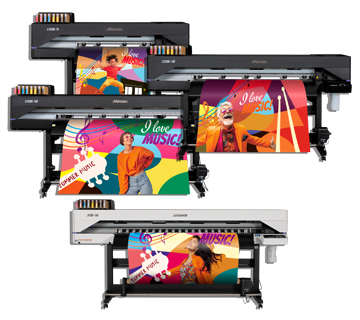
(C)JV200 Series
Eco-friendly print & cut series
- Leverages 330 Series technology for superior performance
- Three print & cut, one print-only for diverse project needs
- Eco-friendly GBL-free SS22 inks
- Easy to maintain, easier to operate
-
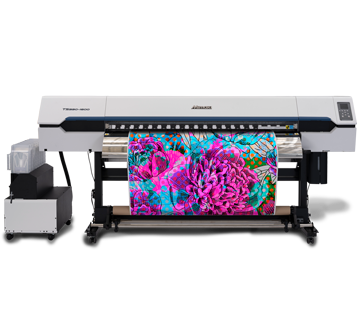
TRAPIS
Transfer Pigment System revolutionising textile printing
- Waterless technology: eco-friendly, efficient, versatile
- Eliminate water waste by 90%
- Easy-to-use system, no complex training
- Print short runs or on-demand production
-
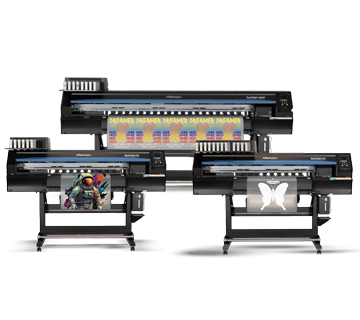
TxF Series
Mimaki’s first Direct-to-Film (DTF) printer
- Highly reliable and stable DTF print workflow
- Degassed ink packs for constant image quality
- White ink circulation to prevent sedimentation
- Combined with Mimaki’s PHT50 pigment ink
-
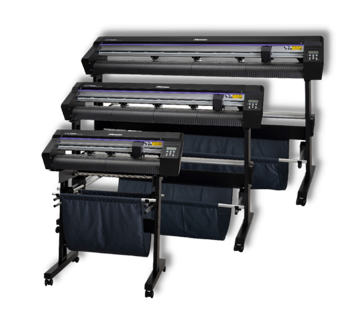
CG-AR Series
Roll-to-roll and sheet fed cutting plotter
- High precision cutting blade dedicated for any material
- Simple Cut & Crease supporting a maximum pressure of 550g
- ID Cut Function for efficient print & cut with Mimaki printers
- Easy to use software available for any type of user
-
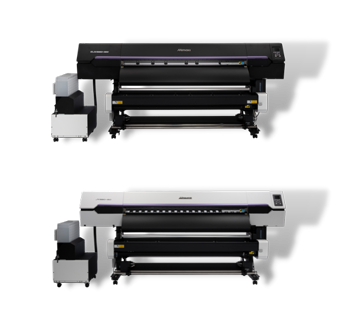
(C)JV330-160
CJV330-160 Print & Cut & JV330-160 Print-only
- XY slitter, inline sheet-fed cutting to reduce post-processing
- Media changer which can hold up to three rolls of media
- Higher image sharpness and more uniform density
- Space saving system that can hold three rolls of media
-
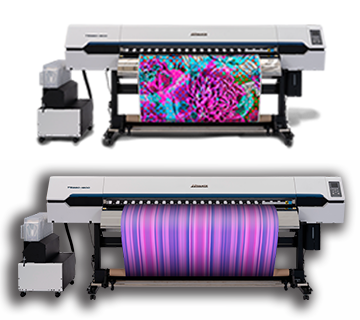
TS330 Series
High quality 1.6m & 1.8m dye sublimation printers
- Fluorescents enable vivid and eye-catching applications
- Upscale production: optional mini jumbo roll and 10kg ink supply
- Throughput increased while operator mistakes are reduced
- High precision print quality
-
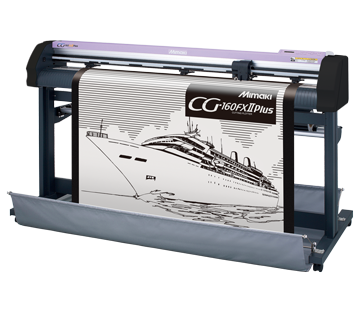
CG-FXIIplus
New world standard of multi-cutting plotter
- New! ID cut enables unmanned continuous operation
- High speed continuous crop mark detection
- Eliminate manual setting of media for increased work efficiency
- Fine-Cut9 plug-in for Adobe Illustrator and CorelDraw


Frequently asked questions about T-shirt printing
There is no single best method for every T-shirt job. The right choice depends on the fabric, design, quantity and level of personalisation.
-DTF works well for short to medium runs, personalised jobs and detailed full-colour designs. You can use DTF on cotton, polyester and blended garments, so it works well when you print different types of T-shirts.
-Sublimation is best suited to polyester garments, especially sportswear. The pigment becomes part of the polyester fibers, so the print does not create a separate layer on the fabric, which makes it more breathable. Please be aware that the panels still needs to be confectioned after sublimation.
-HTV or flex is a practical solution for simple logos, names and numbers. Each design can be cut and heat-applied individually, although detailed artwork can require more cutting and weeding.
-DTG works particularly well for detailed, full-colour designs on cotton T-shirts. It prints directly onto the pre-treatment garment and can produce a soft feel, making it useful for short runs and on-demand production. A pre-treater and a post dryer are essential for a workable solution.
-Screen printing is often the better choice for large quantities of the same design. Preparing the screens takes time and costs more money, but once the setup is complete, the same artwork can be printed efficiently across a large run.
Neither method is better for every job. DTF works across a wider range of fabrics and is practical for personalised jobs and mixed garment types. It can also support higher production volumes when the powdering, curing and heat-press stages are planned to keep up. DTG prints directly onto the garment, is especially well suited to cotton and can produce a softer print feel.
The workflows also differ. DTG requires garment pre-treatment, especially when printing with white ink on dark garments. DTF does not need garment pre-treatment. Instead, the process uses transfer film, adhesive powder, curing and heat pressing.
Consider fabric, print feel, order volume, personalisation and finishing requirements when choosing between them.
DTF can work well on both cotton and polyester. Cotton is the most common choice for DTF T-shirt printing and gives reliable results.
Polyester can also work well with DTF. However, test it first because heat, stretch, or the fabric finish can affect the result. Also, a special powder or lower heat-press temperature might be needed.
For every fabric, we recommend to always test the garment, film, powder and heat-press settings together before production.
Yes. You can use DTF on black, navy and other dark T-shirts. DTF prints a white layer underneath the colours, which helps the design stay bright and visible on dark fabric.
Test the garment before production, especially polyester. Heat can sometimes affect the fabric colour and change the final print. Mimaki’s TxF Series uses a high-density white and circulates the white ink to create a clean bright white. This is especially important when printing on dark T-shirts.
DTF prints are durable through regular wear and washing when you produce and apply the transfer correctly. How long the print lasts depends on the garment, transfer materials, curing, heat-press settings, and how you wash and dry the T-shirt.
Incorrect application can reduce durability. If the transfer does not bond properly, it may start to peel, crack or fade earlier than expected. For professional production, test the garment, film, powder and production settings together before using them for customer orders.
The Mimaki TxF series is known for its unique film compatibility with every brand in the market.