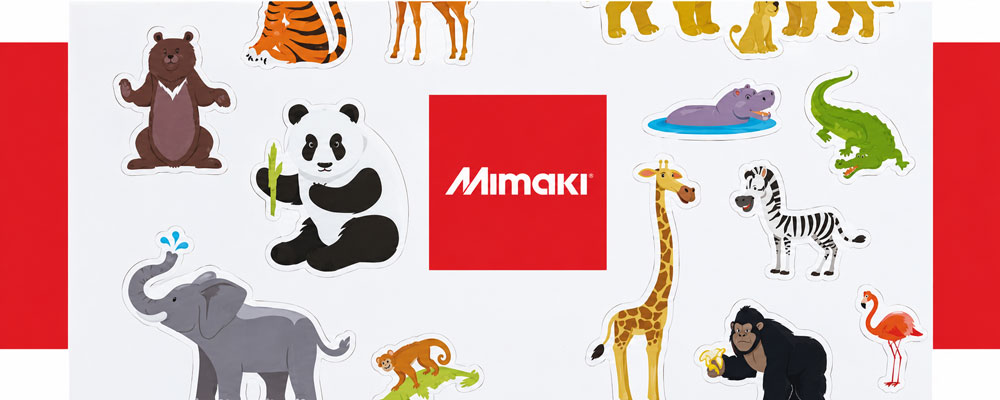
Create custom stickers
Produce durable stickers and decals for branding, promotions and product labelling.
A high-demand application for sign & graphics businesses
Custom sticker printing is one of the most consistent revenue generators in the sign & graphics industry. Material and setup costs are low, relative to selling price, which supports healthy margins. And because designs are often seasonal or campaign-based, customers return for re-prints and new runs rather than a single order.


What businesses expect from a sticker printer
Beyond the basics, buyers look for output that holds up under real production conditions — sharp detail on small text, logos and QR codes, and adhesion that performs well across a range of materials and weather conditions. Just as important is repeatability: colour should match from the first sticker to the five hundredth, without inconsistency between batches.
Print, then cut: workflow control matters
There are two ways to structure this stage of production: an integrated printer and cutter that handles both steps in sequence, or a separate printer and cutting plotter working side by side.
The right setup depends on order volume and floor space. Integrated systems simplify handling for mixed, smaller runs, while separate devices let printing and cutting happen simultaneously, which suits higher-volume production.

See Sticker Printing in Action
Discover how Mimaki's print & cut solutions simplify sticker production from print to precise contour cutting. See how businesses create high-quality, durable stickers with accurate colours, sharp details and an efficient workflow for both short runs and larger production volumes.
Common sticker types you can produce
Sticker printing covers a wide range of business needs, from long-lasting outdoor signage to fast-turnaround promotional packs and everyday product labelling. Each use case comes with its own material, cutting, and durability requirements.

Vinyl decals and signage stickers
Vinyl decals for shop windows, wayfinding and branded signage need to deliver long-lasting outdoor durability, maintaining their quality for years rather than weeks. This requires stable colour on logos and larger graphics, plus a precisely cut edge. This is done with a kiss-cut method which cuts the vinyl but doesn't cut the backing film. After this you can also die-cut to make sticker sheets or single stickers cutting through the backing film.
Promotional and e-commerce sticker packs
Promotional stickers and packaging inserts are usually needed quickly, with designs that change often and quantities that stay small. This is where kiss-cut production fits: cutting through the vinyl layer only, so multiple designs stay on one backing liner, ready to peel and apply. For jobs like these, many businesses print with UV-LED technology, since the ink cures instantly and output can move straight to finishing without having to wait to dry.


Product, safety and identification stickers
Product labels, safety warnings and asset tags often include small text, logos and scannable codes that need to stay sharp and easy to read. They also need strong adhesion to plastic, metal, or glass surfaces. Colour accuracy is just as important, especially for labels that are reordered in small batches and need to match previous print runs.
Mimaki solutions for sticker printing
Mimaki covers sticker printing across its Sign & Graphics range, from entry-level to high-volume production. Eco-solvent CJV Series print & cut machines combine printing and contour cutting in one workflow. The CJV200 Series offer an accessible starting point, while the larger CJV330 models handle higher-volume vinyl sticker production.The UV-LED UCJV Series print & cut machines skip the waiting time to dry entirely, moving straight from print to finishing. For businesses scaling up, Mimaki CG cutting plotters pair with existing Mimaki printers to add contour cutting capacity without slowing production down.
-
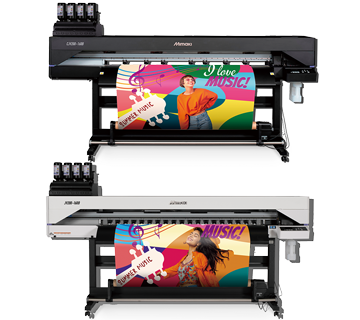
(C)JV200-160B
Eco-solvent advanced print and print & cut
- Superb image quality
- Affordable 1L ink bottles
- Reliable productivity ideal for high demand
- Easy to maintain, easier to operate
-
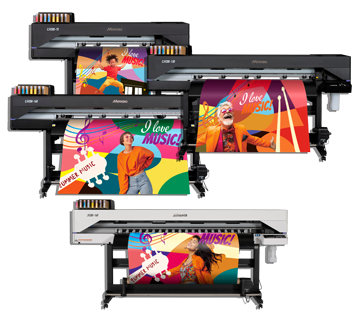
(C)JV200 Series
Eco-friendly print & cut series
- Leverages 330 Series technology for superior performance
- Three print & cut, one print-only for diverse project needs
- Eco-friendly GBL-free SS22 inks
- Easy to maintain, easier to operate
-
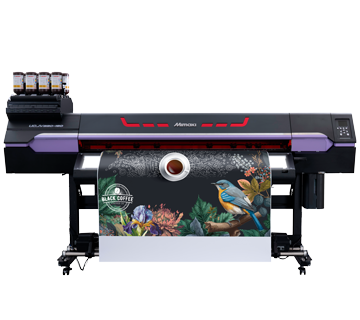
UCJV330-160
UV-LED inkjet print & cut
- Superior quality, even at high speeds
- UV-LED for multi-layer effects
- Integrated printer/cutter to expand applications
- Eco-friendly technology
-
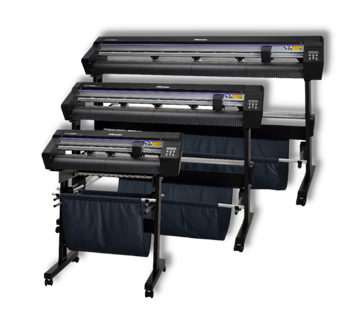
CG-AR Series
Roll-to-roll and sheet fed cutting plotter
- High precision cutting blade dedicated for any material
- Simple Cut & Crease supporting a maximum pressure of 550g
- ID Cut Function for efficient print & cut with Mimaki printers
- Easy to use software available for any type of user
-
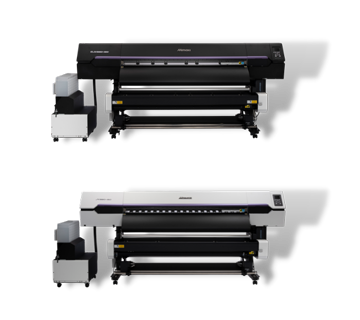
(C)JV330-160
CJV330-160 Print & Cut & JV330-160 Print-only
- XY slitter, inline sheet-fed cutting to reduce post-processing
- Media changer which can hold up to three rolls of media
- Higher image sharpness and more uniform density
- Space saving system that can hold three rolls of media
-
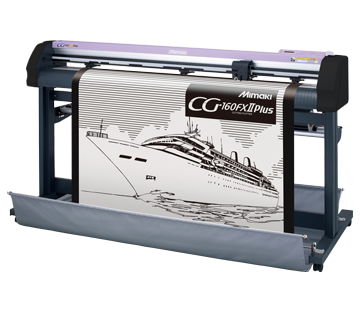
CG-FXIIplus
New world standard of multi-cutting plotter
- New! ID cut enables unmanned continuous operation
- High speed continuous crop mark detection
- Eliminate manual setting of media for increased work efficiency
- Fine-Cut9 plug-in for Adobe Illustrator and CorelDraw
-
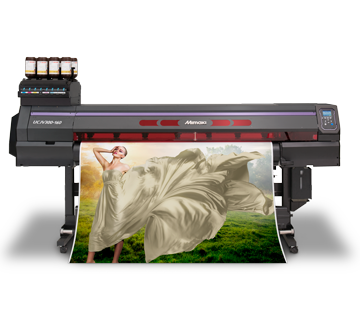
UCJV300 Series
Technologically superior UV-LED printer/cutter
- The most all-round printer with unmatched scratch resistance
- Direct finishing after printing with CMYK
- Variety of print media, even uncoated
- Environmentally friendly UV ink


Frequently asked questions about sticker & decal printing
For professional sticker printing, you need an industrial wide-format printer that can print on self-adhesive materials like vinyl and label material. Standard home or office printers aren't made for this. This printer is usually paired with a cutting plotter, so each sticker is cut precisely to its finished shape. That cutting stage can work in two ways:
• An integrated system: printer and cutter combined in one machine (known as print & cut)
• Two separate devices: a printer paired with a standalone cutting plotter
There are also two main printer technologies, defined by the ink they use:
• Eco-solvent printers: vibrant colours and strong outdoor durability.
• UV-LED printers: cure the ink instantly, so same-day delivery.
The choice between these two printers comes down to your typical order volume, how much delivery speed matters to you, and the materials you plan to print on.
Technically, yes, a home or office inkjet or laser printer can print on basic sticker paper or pre-cut label sheets, and that's fine for occasional use, like printing a single design at home. But it comes with real limits: the ink isn't weatherproof, colours can fade or smudge quickly, and you're restricted to whatever pre-cut shapes or sheet sizes the paper comes in, since a regular printer has no cutting function of its own.
For a business selling or distributing stickers, these limits become a real problem. Customers expect consistent colour across orders, durability that holds up indoors or outdoors, and clean edges cut to the exact shape of the design, none of which a regular printer is built to deliver at scale. That's where dedicated print & cut equipment comes in: it prints on proper self-adhesive vinyl or label film and cuts each sticker to shape in the same workflow, so quality stays consistent whether you're producing five stickers or five thousand.
Yes, sticker printing is one of the more accessible ways to add revenue in the sign and graphics industry. Here's why:
Low cost, good margin: Material costs per sticker are small compared to what customers pay, especially for custom or branded designs.
Repeat business: Many orders are seasonal, tied to campaigns, or linked to product launches, so the same customers come back for re-prints instead of ordering once.
Fast turnaround times: Jobs are usually quick to produce, so you can fit more orders into the same production time.
The real profit driver, however, is production efficiency. Wasted ink, material lost through imprecise cutting and machine downtime all quietly reduce profit margins. A reliable print & cut setup is one that cuts accurately and doesn't need constant manual adjustment to keep the waste low, job after job. Businesses that treat sticker printing as steady, repeatable work, rather than an occasional side job, tend to see the best returns.
In everyday use, the two terms are often used interchangeably, and much of the confusion is fair, both are adhesive vinyl pieces applied to a surface. But there's a distinction rooted in how each is traditionally made.
A decal originally referred to cut vinyl graphics, shapes or lettering cut directly from coloured vinyl film, without any printing involved, then transferred onto a surface using transfer tape. Think of plain-colour car lettering or simple logo cutouts. A vinyl sticker, by contrast, is printed first (full colour, photos, gradients, detailed artwork) and then cut to shape, giving it far more design flexibility than a cut-only decal.
That said, modern print & cut production has blurred this line considerably. Many "decals" sold today are actually printed and cut the same way stickers are, since printing allows for far more detail than cutting vinyl alone. In practice, most sign and graphics businesses now use "decal" and "vinyl sticker" to describe the same printed, cut-to-shape product, and the terms are chosen based on customer expectation more than any strict technical difference.
Beyond the printer and cutter already covered by your equipment choice, a few other pieces complete the workflow:
• RIP software to prepare artwork, manage colour and send cutting instructions to the machine. Mimaki RasterLink software also includes automated features like ID Cut, which reads a printed barcode to align and cut jobs without manual adjustment, useful when running several designs back to back.
• Application tape, used to lift cut stickers off their backing and transfer them cleanly onto the final surface without stretching or misalignment.
• Lamination, if stickers need extra scratch- or weather- resistancy beyond what the ink alone provides, common for outdoor or high-handling applications.
None of this needs to be expensive or complicated to start. Many sign and graphics businesses begin with just the essentials; printer, cutter and RIP software, and add lamination or specialised finishing tools only once demand justifies it.